
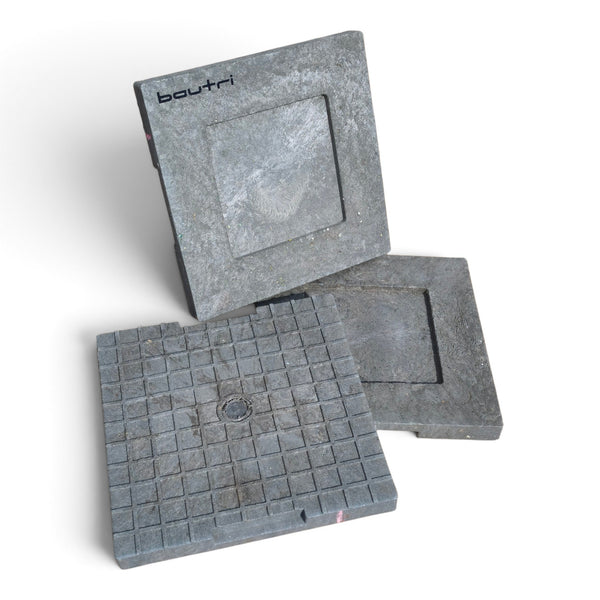
Base plate set
Three plates with a precisely milled recess for the foot element – less ground pressure on soft ground, a level footing on gravel.
€59,95incl. VAT
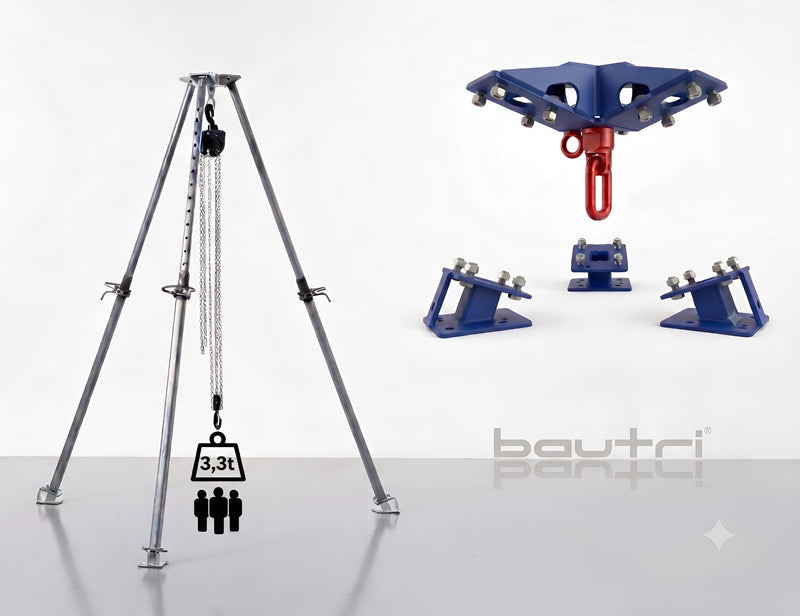
A head plate and three foot elements turn standard EN 1065 building props into a free-standing tripod: for lifting loads, propping and, with Bautri Rescue, personal fall protection. Set up in about 5 minutes by one person, no guying.
 Developed in Germany · Made in Austria by Form-on GmbH
Work lifts and props loads. Rescue does the same and is additionally tested as an anchor point for up to 3 people to EN 795 type B. All values apply without guying.


Mobile Load Lifting System


PPE & Load Combi System
New products, accessories, downloads and improvements at a glance.
Three plates with a precisely milled recess for the foot element – less ground pressure on soft ground, a level footing on gravel.
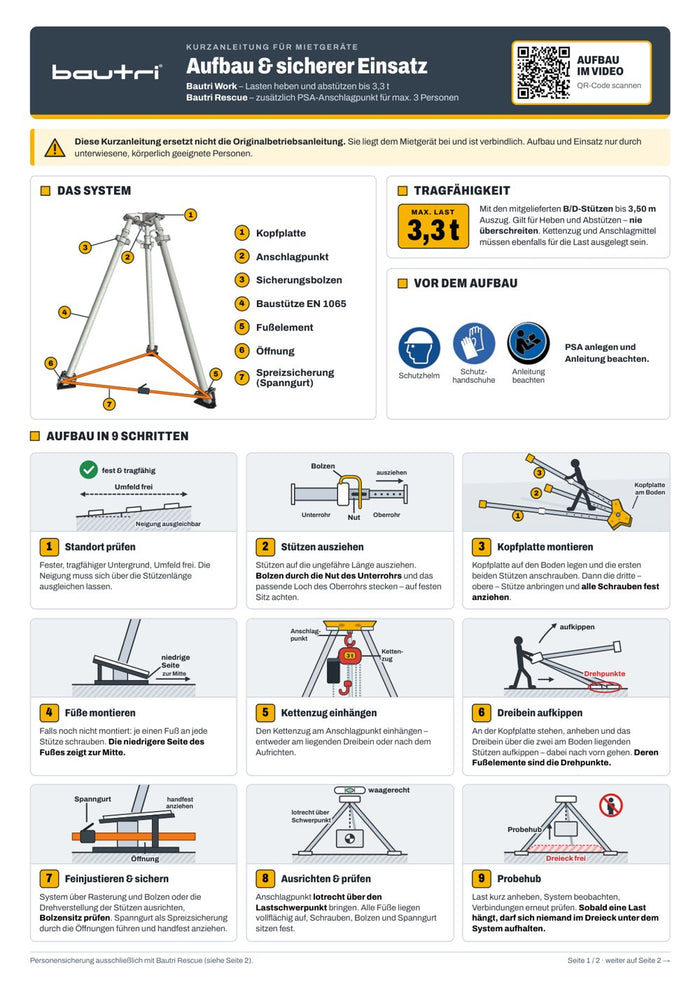
Two A4 pages for every rental: set-up in 9 steps, lifting rules, dismantling and a handover record. Print it and hand it over with the equipment.
Always available under Certification, standards & data sheets
Document available in German.
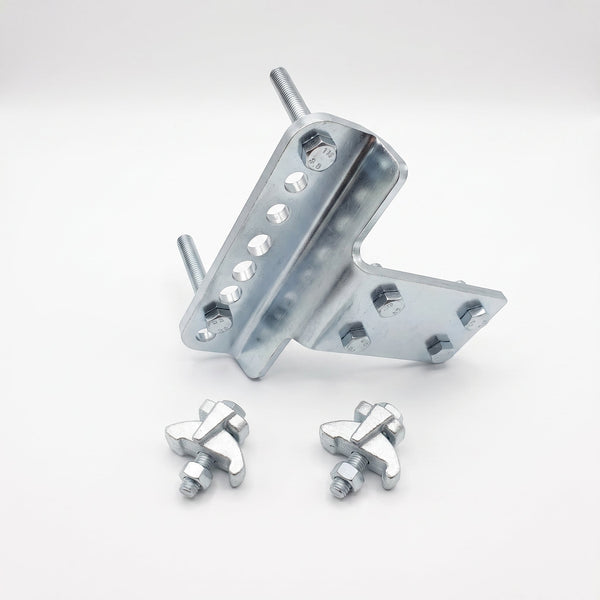
KA101 adapter flange with two beam clamps: place a steel beam (flange 60–100 mm) on the head plate and clamp it securely.
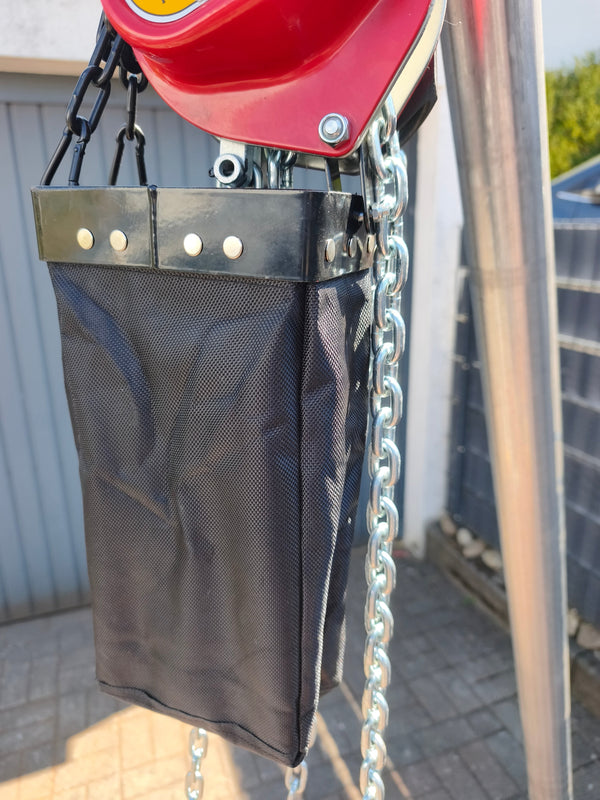
Collects the loose chain right at the chain hoist – nothing gets in the way or drags across the ground.
"The Bautri system is a permanent part of our recovery unit's equipment and has proven itself as an effective tool. It lets us optimally complement our gear and set up a reliable tripod system in the shortest possible time."
Bautri Rescue →"Thanks for the awesome product you developed! We can no longer imagine many of our jobs without it."
Bautri Work →"Before the Bautri system, we wondered whether we'd ever be able to dig out tangled shrub roots... Great invention, fantastic uses in the garden too!"
Pulling roots →A head plate and three foot elements turn standard EN 1065 building props into a free-standing tripod: for lifting with a chain hoist, for propping and, with Bautri Rescue, for personal fall protection. The film shows the setup.
With class B/D or D props up to 3.50 m extension; 2.5 t up to 4.00 m extension. Enough for root balls, tree stumps, foundation stones or machine parts.
Each prop is adjusted in length individually, so slopes and steps are compensated. The foot elements have an anti-slip coating; base plates are available for soft ground.
By one person, no special tools. The adapter weighs approx. 14 kg (Rescue approx. 15 kg); the props are placed one by one. No guying: the tripod stands on its own.
Tested by DEKRA with 50 kN tensile load at 3.50 m (rated 3.3 t) and 38 kN at 4.00 m (rated 2.5 t), each without guying. Manufactured by Form-on (Doka Group) in Austria.

Can't find an answer? Our team is happy to advise you personally.
Request adviceBautri WORK is approved for material loads under Machinery Directive 2006/42/EC. Bautri RESCUE is additionally certified to EN 795 B / CEN/TS 16415 for fall protection of persons.
Yes — that's the core idea of the Bautri system. It works with commercially available construction props to EN 1065 as well as equivalent aluminum spindle props.
The load rating depends on the props used and their extension. With BD props under 3.50 m extension, 3.3 t is approved; with standard props, 2.5 t.
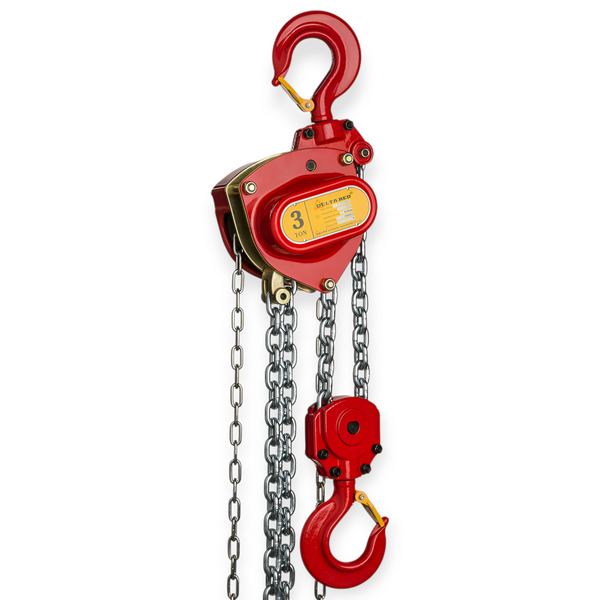
Yes. A chain hoist or pulley block can be attached directly to the Bautri tripod via the load eye on the head piece — e.g. our DELTA RED spur-gear chain hoist (3 t, 3 m lifting height), available individually or in the Work and Rescue sets.
Yes. The Bautri adapter (Work approx. 14 kg, Rescue approx. 15 kg) is ready for use by a single person in about 5 minutes — no heavy hauling, no complicated assembly, no special tools.
Thanks to simple leveling with standardized construction props, you create a safe, stable base on virtually any load-bearing surface.
Bolted connections are demonstrably safer under load and can be reproducibly tested — DEKRA certification to EN 795 B requires this type of connection. Compatibility is also decisive: the upper and lower anchor plates of all construction props to EN 1065, and equivalent aluminum spindle props, share a common denominator — an 80 × 80 mm bolt pattern with four holes of at least 12 mm diameter. The anchor plates themselves often vary in size or thickness, are slightly bent, or soiled with mortar. This standardized bolt pattern makes that irrelevant: the bolted connection always fits and creates a highly stable joint. A plug-in system could not accommodate this tolerance for deformed, worn, or soiled anchor plates.


